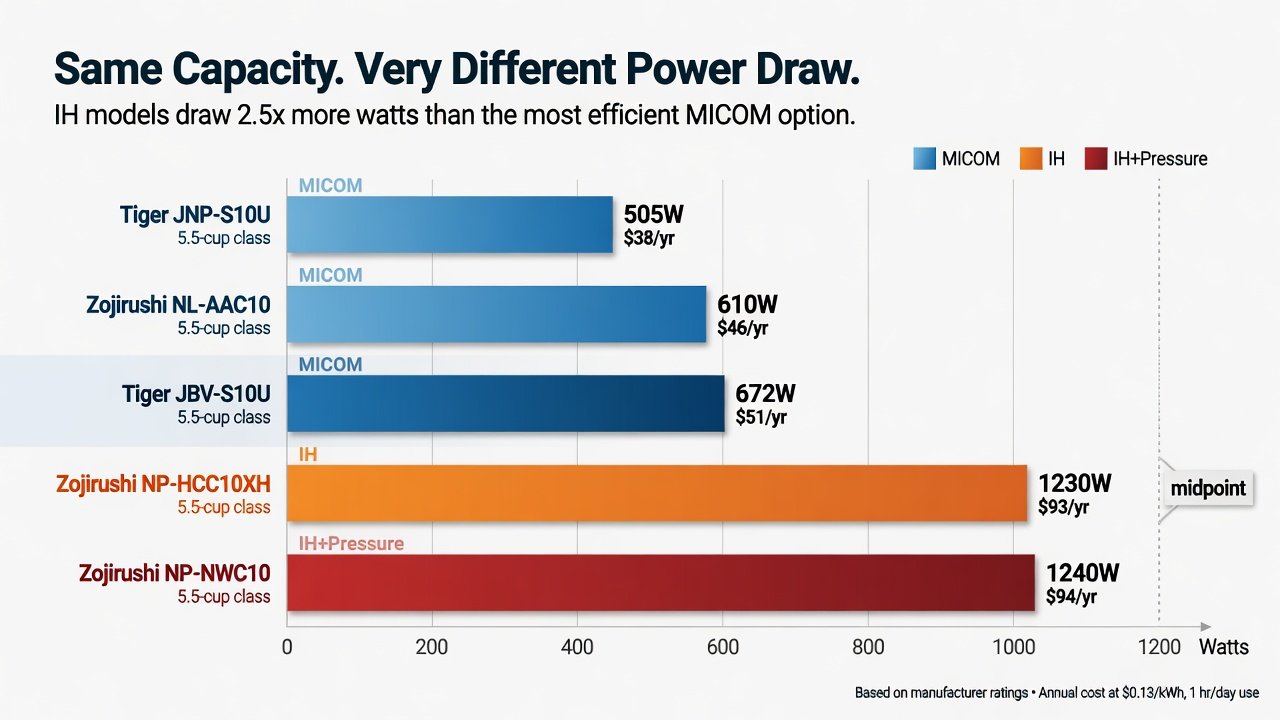
Technology type — not brand — is the single biggest driver of rice cooker energy use. For the same 5.5-cup capacity, an IH+pressure model draws 2.5× the peak wattage of a MICOM model. That gap adds roughly $17 per year for daily cooks — and climbs fast if you leave the warmer running. Here’s the full cross-model breakdown, built from manufacturer specs and the only published wattmeter test in the independent literature.
What Experienced Cooks Need to Know First
- Technology type dominates energy use: IH+pressure models (1,240W) draw 2.5× more peak wattage than MICOM models (505W) at identical 5.5-cup capacity, adding ~$17/year at daily 30-minute cooking — per manufacturer wattage data analyzed by UDPOWER (2024).
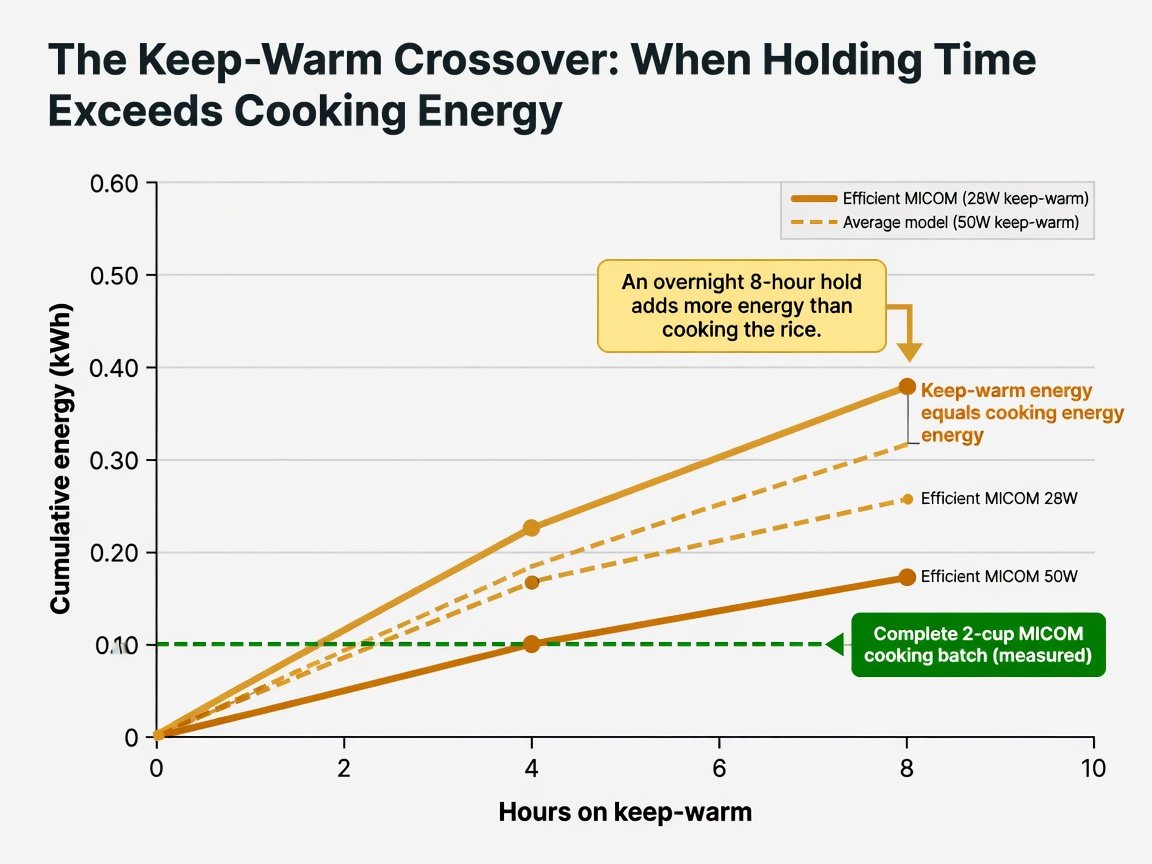
- Keep-warm is the hidden variable: An 8-hour overnight hold at 40W consumes 0.32 kWh — more than an entire 2-cup MICOM cooking batch (0.14 kWh, measured). For meal-prep cooks, hold time matters as much as technology type.
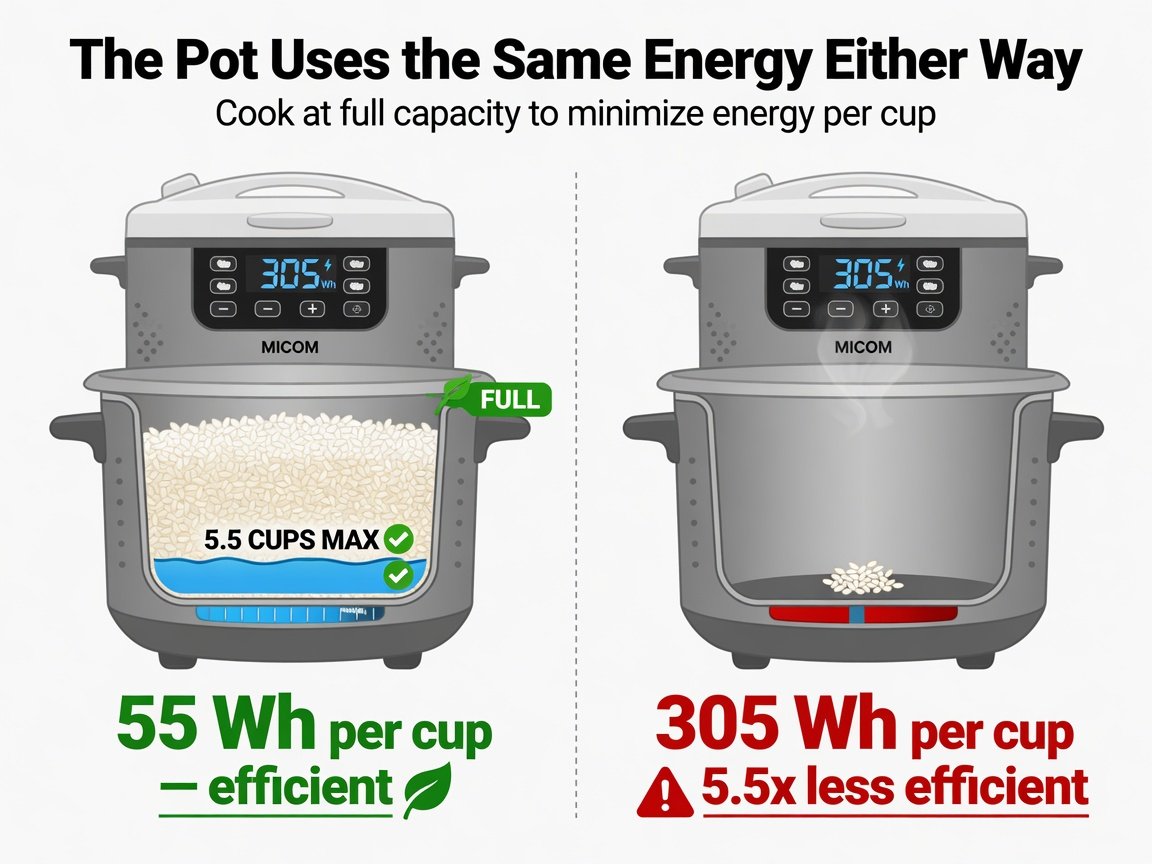
- Batch size creates a 5.5× per-cup efficiency swing: A 5.5-cup MICOM cooker uses the same ~305 Wh whether you cook 1 cup or fill the pot. Full-capacity cooking cuts per-cup energy from ~305 Wh to ~55 Wh.
- No US energy standard exists for rice cookers as of June 2026: ENERGY STAR covers cooking ranges and tops only. Japan’s Top Runner program — which classifies cookers into 8 mandatory efficiency categories — is the world’s most rigorous benchmark and the closest thing to a global standard.
What Does “Energy Per Cup” Actually Measure?
Most rice cooker spec sheets give you one number: rated wattage. That tells you peak draw — not total energy consumed per batch. To get energy per cup, you need watts, cook time, and batch size together. Almost no manufacturer publishes all three in one place.
The formula is straightforward. Estimated Wh per cup = Rated Watts × Cook Time (hours) ÷ Capacity (cups). Every formula-derived figure in this article assumes a 30-minute white rice cycle at full rated capacity. That’s a conservative, apples-to-apples baseline. IH models often cook faster than 30 minutes, which would actually reduce their real Wh/cup in practice — something the comparison table’s footnote flags explicitly.
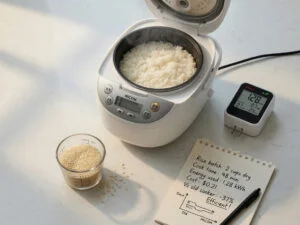
There is exactly one published independent wattmeter measurement of a specific consumer model in the available literature. A Kill-A-Watt test by EcoRenovator.org (2013) measured the Zojirushi NS-ZCC (2-cup MICOM) at 0.14 kWh per 2-cup batch. That works out to 70 Wh per cup — directly measured. Every other figure in the comparison table below is formula-derived from rated wattage, which is an important distinction to keep in mind.
One more nuance worth knowing: rice cookers don’t run at peak wattage continuously. They cycle their heating element on and off during cooking. A UK consumer wattmeter test found an unnamed model averaging 472W actual draw against a ~700W rated spec. Real draw is lower than the nameplate figure — which means formula-derived estimates are slightly conservative. The relative rankings between models hold, but the absolute Wh/cup numbers overstate actual consumption by roughly 30–40%.
The 2026 Rice Cooker Energy Efficiency Comparison Table
The table below covers nine current-generation models across three technology types, sorted by estimated Wh per cup at full capacity. The Zojirushi NS-ZCC is pinned at the top as the only wattmeter-verified figure in this dataset. All other values are formula-derived. Annual cost assumes daily 30-minute cooking at $0.13/kWh — the US average rate used throughout this article. Formula: (Rated W ÷ 1,000) × 0.5 hr × 365 days × $0.13.
| Model | Technology | Capacity | Rated Wattage | Est. Wh/cup | Annual Cost* |
|---|---|---|---|---|---|
| Zojirushi NS-ZCC | ★ MEASURED | 2 cups | 700W | 70 Wh/cup Kill-A-Watt verified |
$17/yr |
| Aroma ARC-914SBD | MICOM | 4 cups | 350W | 44 Wh/cup | $8/yr |
| Tiger JNP-S10U | MICOM | 5.5 cups | 505W | 46 Wh/cup | $12/yr |
| Cuckoo CR-0631F | MICOM | 6 cups | 580W | 48 Wh/cup | $14/yr |
| Zojirushi NL-AAC10 | MICOM | 5.5 cups | 610W | 56 Wh/cup | $15/yr |
| Tiger JBV-S10U | MICOM | 5.5 cups | 672W | 61 Wh/cup | $16/yr |
| Zojirushi NS-LGC05 | MICOM | 3 cups | 450W | 75 Wh/cup | $11/yr |
| Panasonic SR-DF101 | MICOM | 5 cups | 750W | 75 Wh/cup | $18/yr |
| Zojirushi NP-HCC10XH | IH | 5.5 cups | 1,230W | 112 Wh/cup | $29/yr |
| Zojirushi NP-NWC10 | IH+Pressure | 5.5 cups | 1,240W | 113 Wh/cup | $30/yr |
| * Annual cost = (Rated W ÷ 1,000) × 0.5 hr × 365 × $0.13/kWh. Wh/cup = Rated W × 0.5 hr ÷ capacity. All figures except the Zojirushi NS-ZCC are formula-derived from manufacturer-rated wattage. IH models typically cook faster than 30 min, which reduces their actual Wh/cup — this table presents a conservative 30-min baseline for cross-model comparability. Only the Zojirushi NS-ZCC (★ 70 Wh/cup) is directly wattmeter-measured (EcoRenovator.org, 2013). Sources: UDPOWER (2024); EcoRenovator.org (2013); KitchVS (2025). | |||||
The pattern is clear. MICOM models cluster between 44 and 75 Wh/cup at full capacity. IH and IH+pressure models jump to 112–113 Wh/cup — a 1.5–2.6× increase over the best MICOM in the dataset. The efficiency gap between technology tiers dwarfs any variation within the MICOM category itself. Switching from the Aroma ARC-914SBD to the Panasonic SR-DF101 (both MICOM) adds 31 Wh/cup. Switching from any 5.5-cup MICOM to the Zojirushi NP-HCC10XH IH adds 51–66 Wh/cup.
Why Technology Type Sets Your Energy Bill More Than Brand Does
Look at the comparison table for a moment. The most expensive MICOM model to run (Panasonic SR-DF101 at $18/yr) still costs less annually than the cheapest IH model (Zojirushi NP-HCC10XH at $29/yr). Brand doesn’t bridge that gap. Technology type does — every time.
The reason is physics. MICOM rice cookers use a standard electric heating plate under the pot, regulated by a microprocessor. IH models use electromagnetic coils that heat the entire inner pot directly and uniformly. More responsive, better at complex temperature curves, capable of pressure cooking — and significantly more power-hungry at peak draw. Both technologies do the same job. One draws 2.5× the electricity to do it.
According to manufacturer wattage data analyzed by UDPOWER (2024), MICOM models in the 5.5-cup class range from 505W (Tiger JNP-S10U) to 672W (Tiger JBV-S10U). IH models in the same class start at 1,230W. That’s not a marginal upgrade in energy use — it’s a category-level jump. The two Zojirushi IH and IH+pressure models in this dataset (NP-HCC10XH and NP-NWC10) draw 1,230W and 1,240W respectively — essentially identical peak wattage despite using different heating mechanisms.
There is a legitimate counterpoint here. IH models often finish a white rice cycle in 25–30 minutes while MICOM models take 30–40 minutes. At equal cook times, IH uses 2.5× more energy per cycle. In real-world use, the gap narrows to roughly 1.8–2× because of IH’s speed advantage. That’s still a substantial difference — but it’s worth knowing that the table’s 30-minute baseline is conservative for IH models specifically.
Keep-Warm Mode: The Energy Cost Most Cooks Don’t Track
The cooking cycle gets all the attention. Keep-warm rarely does — until you actually run the numbers. According to data compiled by We Know Rice (2023), typical consumer MICOM rice cookers draw 28–50W in keep-warm mode. That’s roughly 4–10% of peak cooking wattage. For short holds, the cost is genuinely negligible: one hour at 40W costs $0.005 — half a cent.
The EcoRenovator.org Kill-A-Watt test — the only published measured keep-warm data for a specific consumer model — found the Zojirushi NS-ZCC draws exactly 28W continuously in keep-warm mode. A 30–45 minute meal-length hold added just 0.01 kWh to the 0.14 kWh batch total. Standby draw was below meter detection threshold — effectively 0W. For a meal-time hold, keep-warm is barely a rounding error on your energy bill.
The math changes dramatically when you leave the cooker on overnight. An 8-hour hold at 40W draws 0.32 kWh. That single overnight session uses more electricity than an entire 2-cup MICOM cooking batch (0.14 kWh measured). A cook who runs keep-warm from dinner at 6pm to breakfast at 7am is spending more energy on the hold than on cooking the rice. For meal-prep cooks who batch-cook on Sunday and hold all afternoon, keep-warm can match — or exceed — total cooking energy for the week.
An 8-hour overnight hold at 40W = 0.32 kWh — more energy than cooking a full 2-cup MICOM batch (0.14 kWh measured). If you leave your rice cooker on warm from dinner to breakfast, you’re spending more energy on holding than on cooking. Transfer rice to a sealed container and refrigerate instead. Reheat per portion. A 60-second microwave reheat uses roughly 0.02 kWh — a fraction of an 8-hour hold. — Source: We Know Rice, 2023; EcoRenovator.org, 2013
For experienced cooks, keep-warm discipline is the most actionable energy lever available after the initial technology-type choice. You can’t change your cooker’s rated wattage. You can absolutely control how long it sits on warm. If you cook ahead, transferring rice to a container and refrigerating it will almost always use less total energy than a multi-hour warm hold — even accounting for reheating.
The Batch-Size Efficiency Trap Experienced Cooks Should Avoid
Here’s a fact that surprises most rice cooker owners: your cooker uses essentially the same total energy whether you cook one cup or fill it to capacity. The heating cycle is fixed. The appliance doesn’t scale its energy output based on how much rice is in the pot.
The arithmetic is stark. A 5.5-cup MICOM model rated at 610W running a 30-minute cycle consumes approximately 305 Wh total. Cook 5.5 cups and that works out to about 55 Wh per cup — genuinely efficient. Cook 1 cup in that same pot and it’s still ~305 Wh total — but now that’s 305 Wh per single cup. That’s a 5.5× per-cup efficiency penalty from batch size alone, with zero change in the model you own or how you operate it.
The rule is simple: cook at 75–100% of rated capacity whenever possible. If you consistently cook small batches, a compact 2–3 cup MICOM model will deliver better per-cup energy numbers than running a 5.5-cup cooker at one-fifth capacity. The measured Zojirushi NS-ZCC case is instructive here — a 2-cup model at full capacity recorded 70 Wh/cup measured, outperforming the formula estimate for several larger MICOM models running at partial load.
Rice Type and Cooking Time Multiply Your Per-Cycle Energy Cost
The comparison table assumes a 30-minute white rice cycle. That’s a fair baseline for cross-model comparison — but it significantly understates the energy cost of brown rice, mixed grain, or slow-cook settings.
White rice takes 20–30 minutes on a typical MICOM model. Brown rice takes 45–60 minutes on the same machine. According to Bluetti Power’s 2024 energy analysis, a 700W cooker running a brown rice cycle consumes 0.52–0.70 kWh vs. 0.23–0.35 kWh for white rice — a 2–3× difference per cycle from rice type alone, at identical wattage and capacity.
For experienced cooks who rotate between white rice, brown rice, and mixed grain cycles, cook time is a per-cycle energy multiplier that can rival the technology-type gap. Cooking brown rice daily in a 700W MICOM adds roughly 30–40 extra minutes of heating time per batch compared to white rice. Over a year of daily cooking, that additional time can account for as much extra energy as the annual premium for running a mid-tier MICOM over the lowest-wattage model in the category.
The practical implication is counterintuitive. A fast-cooking 600W MICOM with a dedicated 45-minute brown rice program may use less per-cycle energy than a 1,200W IH model running a 30-minute brown rice cycle — even though the IH’s speed advantage is significant for white rice. When cook time changes dramatically between rice types, the wattage advantage of a lower-draw model compounds. Always estimate per-cycle energy using actual cycle time for your most common rice type, not a generic 30-minute baseline.
Why There’s No ENERGY STAR Label on Your Rice Cooker
If you’ve ever looked for an ENERGY STAR rating when shopping for a rice cooker — or assumed that premium models must meet some government efficiency threshold — you were searching for something that doesn’t exist.
As of June 2026, the US ENERGY STAR program certifies electric cooking tops and ranges (qualifying threshold: annual energy consumption ≤195 kWh/yr), but explicitly leaves rice cookers outside its scope. There is no federal energy efficiency standard, no mandatory labeling requirement, and no government-mandated certification process for rice cookers sold in the United States. US consumers have no independent government verification of any manufacturer’s efficiency claims.
International test methodologies for rice cookers compound the problem. According to a Lawrence Berkeley National Laboratory analysis (2009), Japan tests rice cookers with manufacturer-specified water levels using milled rice; South Korea tests at 80% capacity with no rice at all; Hong Kong tests at 80% capacity with white rice. These three protocols are mutually incompatible. Efficiency ratings derived under different national standards cannot be meaningfully compared — a critical caveat for any cross-brand comparison table that draws specifications from multiple markets, including this one.
Without a US federal standard or ENERGY STAR certification, the only reliable way to compare rice cooker efficiency is rated wattage + capacity (for formula estimates) or a direct wattmeter test. Manufacturer efficiency claims made outside Japan’s Top Runner framework have no independent verification. When comparing models, use this formula: (Rated W × cook time hrs ÷ capacity cups) = Wh/cup. It’s the only tool that works consistently across brands and markets.
How Japan’s Top Runner Program Sets the Global Benchmark
Japan runs the world’s most rigorous rice cooker energy efficiency program. Understanding how it works explains why Japanese-designed brands like Zojirushi and Tiger consistently outperform most of the global market on verifiable efficiency metrics — and why US buyers benefit indirectly from a standard they’ll never see labeled on a box.
The Top Runner program, analyzed in depth by Lawrence Berkeley National Laboratory (2009), classifies rice cookers into 8 mandatory categories based on two variables: heating technology (IH vs. non-IH) and capacity range (4 tiers). Each category has a mandatory annual energy consumption target that all manufacturers selling in that category must meet. The program uses a “best product sets the standard” design — the most efficient product in each production cycle raises the minimum threshold for every manufacturer in the next cycle. Efficiency improves not through regulatory negotiation, but through engineering competition.
This ratcheting mechanism produced measurable results. Between 1993 and 2004, IH warm-mode efficiency improved by approximately 12% across the category. In a mature appliance segment where engineering headroom is limited, a 12% forced efficiency gain over 11 years represents substantial real-world progress. The LBNL analysis also notes that South Korea, Hong Kong, and Thailand operate similar (though less rigorous) frameworks — meaning the global efficiency frontier for rice cookers is set largely by Asian regulatory competition, not US consumer demand.
For US buyers, the takeaway is pragmatic: Japanese-market brands subject to Top Runner requirements have structural engineering incentives to optimize keep-warm draw and standby efficiency that US-only brands simply don’t face. When comparing models across brands, this regulatory asymmetry is worth accounting for — even if it’s invisible on the spec sheet.
Case Study: The Only Published Wattmeter Test
The Zojirushi NS-ZCC is a discontinued 2-cup MICOM model — but it holds a unique place in rice cooker energy data. It’s the only consumer rice cooker with a complete, published Kill-A-Watt measurement available in the independent literature. EcoRenovator.org (2013) tested it with a calibrated Kill-A-Watt meter across multiple cooking cycles and keep-warm periods. The results are the most reliable per-model figures available anywhere.
Zojirushi NS-ZCC (2-Cup MICOM) — Kill-A-Watt Measurement, EcoRenovator.org (2013)
- Peak rated wattage: 700W (nameplate)
- Per-batch energy (2 cups, white rice): 0.14 kWh measured
- Implied average draw during cooking: ~336W (inferred from kWh ÷ cook time — roughly 48% of rated peak)
- Per-cup energy: 70 Wh/cup — the only independently verified per-cup figure in this dataset
- Keep-warm draw: 28W continuously (measured)
- 30-min keep-warm hold energy: 0.01 kWh added (≈ +7% above cooking energy)
- Standby draw: <0.01W (below Kill-A-Watt detection threshold — effectively 0W)
Source: EcoRenovator.org (2013) — Zojirushi Cooks Perfect Rice, Saves Energy. This is the sole independently measured per-cup data point in the publicly available consumer literature as of June 2026. All other per-cup figures in this article are formula-derived from rated wattage. The NS-ZCC is discontinued; current equivalent models include the Zojirushi NS-LGC05 and Zojirushi NL-AAC10.
The case study reveals something important: the NS-ZCC’s actual average draw was roughly 336W — about 48% of its 700W rated peak. If formula-derived estimates at full 30-minute cycles already overshoot real-world energy use by ~50%, the Wh/cup figures in the comparison table are conservative benchmarks rather than actual meter readings. Use them for cross-model comparison and budget planning, not as precise predictions of your electricity bill.
How to Minimize Your Rice Cooker’s Energy Use Per Cup
If you want to actively cut per-cup energy costs, the following steps are ranked by impact — from highest leverage to fine-tuning. Work through them in order. The first two steps alone account for the vast majority of efficiency gains available to any cook.
If you cook 1–2 cups per session, a 2–3 cup MICOM model will consistently outperform a larger cooker running at partial capacity. The only measured per-cup figure in this dataset — 70 Wh/cup for the 2-cup Zojirushi NS-ZCC — beats the formula estimate for several larger MICOM models. Right-sizing is the single highest-impact move available and requires zero change in cooking habits.
Cooking at full capacity cuts per-cup energy by up to 5.5× compared to a single-cup batch in a large cooker. Batch-cook for two or three days at a time if your schedule allows — the energy math strongly favors less-frequent, larger batches over daily partial-capacity cooks.
Keep-warm is under a penny per hour — genuinely cheap for meal-length holds. But an 8-hour hold at 40W adds 0.32 kWh: more than a full cooking cycle. For anything over two hours, transfer rice to a sealed container and refrigerate. Reheat per portion in a microwave (~0.02 kWh per serving) rather than holding the entire batch warm.
IH models draw 1,230–1,240W vs. 505–672W for comparable MICOM models at 5.5-cup capacity. At daily use, IH costs $13–17 more per year in electricity. Over a typical 7-year appliance lifespan, that’s $91–$119 in extra operating cost — not counting IH’s higher purchase price. IH produces genuinely superior rice for many cooks. But it’s not the efficient option.
Brown rice takes 45–60 minutes vs. 20–30 for white rice — a 2–3× per-cycle energy multiplier at identical wattage. If you switch primarily to brown rice or mixed grains, recalculate your per-cycle energy estimate using actual cycle time, not the 30-minute white rice baseline.
Most current MICOM models include a delay-start feature. Set it so rice finishes minutes before you sit down. This eliminates keep-warm time entirely without any sacrifice in convenience — and it’s the easiest behavioral change on this list, costing nothing and requiring no equipment adjustment.
What to Expect from Rice Cooker Efficiency in 2027
The regulatory and market trends visible in mid-2026 suggest a few developments worth watching before your next purchase decision.
Japan’s Top Runner program continues to tighten efficiency targets across all 8 mandatory categories. Zojirushi and Tiger — both subject to Japanese efficiency regulations — face consistent engineering pressure to optimize warm-mode and standby draw, the two highest-leverage variables outside peak cooking wattage. Expect incremental improvements in keep-warm efficiency from both brands through 2027, particularly in the IH category where warm-mode draw historically runs higher relative to cooking mode.
In the US market, the absence of federal rice cooker energy standards shows no sign of changing in the near term. ENERGY STAR’s 2026 product roadmap for cooking appliances focuses on induction cooking ranges and smart kitchen platforms — not countertop rice cookers. US consumers will likely remain dependent on manufacturer specs, independent wattmeter testing, and formula-based comparisons like this one for the foreseeable future.
One technology development worth tracking: pressure IH models like the Zojirushi NP-NWC10 significantly reduce cook time for brown rice and harder grains — the high-energy cycles where MICOM’s time advantage reverses. As IH+pressure matures, its per-cycle energy disadvantage narrows further in real-world use for diverse grain cooks. Whether that represents a genuine efficiency win depends on whether manufacturers begin publishing cycle-specific energy data — something almost none currently do.
For 2027, the most likely consumer-visible improvements will be in keep-warm efficiency for mid-tier MICOM models (following Top Runner pressure) and possibly in app-connected delay-start features that reduce incidental keep-warm time. Models with automatic “keep-warm off” timers — set to shut down after 60 or 90 minutes — represent the simplest product-level fix for the 8-hour crossover problem identified in this article.
Frequently Asked Questions
How much energy does a rice cooker use per cup of rice?
The only published wattmeter test of a specific model recorded 70 Wh per cup — the Zojirushi NS-ZCC (2-cup MICOM), measured at 0.14 kWh for a 2-cup batch using a Kill-A-Watt device (EcoRenovator.org, 2013). For current 5.5-cup MICOM models, formula estimates at full capacity range from 46–75 Wh/cup. IH+pressure models in the same class come in at ~112–113 Wh/cup based on rated wattage. The biggest single variable isn’t the model — it’s batch size. Cooking one cup in a 5.5-cup cooker uses roughly the same total energy as filling the pot, which multiplies per-cup energy by up to 5.5×.
Does an IH rice cooker use more electricity than a MICOM model?
Yes — significantly more at peak draw. IH models draw 1,230–1,240W rated, compared to 505–672W for comparable 5.5-cup MICOM models — a 2.5× peak wattage gap. At daily 30-minute cooking, that costs roughly $13–17 more per year at $0.13/kWh. In practice, IH models often cook faster than MICOM (roughly 25–30 min vs. 30–40 min for white rice), which partially narrows the total kWh gap per batch. At equal cook times, however, IH uses approximately 2.5× more energy per cycle. Whether IH is “worth it” on energy grounds is a personal call — the rice quality and speed advantages are real — but the efficiency cost is also real and substantial over the life of the appliance.
How much does leaving a rice cooker on keep-warm cost per hour?
Keep-warm draws 28–50W on most consumer MICOM models. At $0.13/kWh, that’s $0.004–$0.007 per hour — under a penny. A meal-length 1-hour hold adds just $0.005 to your bill. The catch comes with extended holds: an 8-hour overnight hold at 40W consumes 0.32 kWh and costs about $0.04. That single hold uses more energy than an entire 2-cup MICOM cooking batch (0.14 kWh measured). For cooks who leave rice on warm from dinner to the next morning, the keep-warm phase can contribute more total energy than the cooking cycle itself. The measured keep-warm figure (28W) comes from the EcoRenovator.org Kill-A-Watt test of the Zojirushi NS-ZCC — the only published keep-warm measurement for a specific consumer model as of June 2026.
Is there an ENERGY STAR rating for rice cookers?
No. As of June 2026, ENERGY STAR certifies electric cooking tops and ranges (threshold: ≤195 kWh/yr annual energy) but does not cover rice cookers. No US federal energy efficiency standard exists for this appliance category, and there is no mandatory efficiency label. Japan’s Top Runner program is the world’s most rigorous standard — it classifies cookers into 8 mandatory categories with annual energy targets and has driven approximately 12% IH warm-mode efficiency improvement since 1993. US buyers must rely on manufacturer specs, independent wattmeter testing, or formula-derived estimates when comparing models.
Does cooking a small batch in a large rice cooker waste energy?
Yes — significantly. A rice cooker runs essentially the same heating cycle regardless of batch size. A 5.5-cup MICOM model at 610W running a 30-minute cycle consumes approximately 305 Wh total — whether you cook 1 cup or 5.5 cups. At full capacity that works out to ~55 Wh per cup. At one cup, it’s ~305 Wh per cup — a 5.5× efficiency penalty from batch size alone. The practical fix: cook at 75–100% of rated capacity whenever possible. If you consistently cook small batches, a right-sized 2–3 cup MICOM model will deliver meaningfully better per-cup energy figures than a large cooker running well below capacity.
Bottom Line: How to Apply This Data to Your Next Decision
If you take one thing from this comparison table, make it the technology hierarchy. IH+pressure → IH → MICOM → compact MICOM: that ordering tracks peak wattage, per-cup energy at equal capacity, and annual operating cost in descending efficiency order. Brand variation within each tier is real but smaller than the tier-to-tier gap. Switching brands within MICOM saves pennies per year. Switching from IH to MICOM saves $13–17 per year.
Here’s a practical decision sequence to work through over the next few weeks:
- Week 1 — Audit your actual batch size. How many cups do you cook per session? If it’s consistently below 50% of your cooker’s rated capacity, you’re paying a per-cup efficiency penalty every day. A right-sized compact model may be your single best efficiency upgrade.
- Week 1 — Track your keep-warm behavior. Do you regularly hold rice for more than two hours? If so, a delay-start habit or a simple container-and-refrigerate workflow will save more energy annually than any model switch.
- Before your next purchase — compare technology tiers first, brands second. Use the Wh/cup column in this article’s table as your reference. If energy efficiency matters to you, the MICOM tier at 44–75 Wh/cup (full capacity, formula-derived) will always outrun IH at 112–113 Wh/cup on annual operating cost.
- Before your next purchase — ignore efficiency claims without methodology. With no US federal standard and three mutually incompatible international test protocols, any brand efficiency claim that doesn’t cite its test conditions is not verifiable. Use the formula: (Rated W × 0.5 hr ÷ capacity cups) = Wh/cup. It’s consistent, transparent, and built from the one number every manufacturer actually publishes.
If you want to go further, a $25 Kill-A-Watt meter and two batches of rice will give you better real-world data than any spec sheet. The Zojirushi NS-ZCC case shows exactly what that looks like: 0.14 kWh per batch, 70 Wh per cup, 28W keep-warm — clean, repeatable numbers that turned a single consumer test into the most-cited independent rice cooker energy measurement available more than a decade later. Your own measurement, properly documented, would be the second.
Choose MICOM for daily efficiency. Cook at capacity. Limit keep-warm to under two hours. For brown rice, factor the 2–3× cook-time multiplier into your per-cycle estimate. And know that no US government standard validates manufacturer efficiency claims — the formula and a wattmeter are your only reliable tools.