
We’ve all been there—standing over a pot of rice, wondering if we’ve added too much water or if it’s actually cooking properly. Rice cookers eliminate that guesswork entirely, and honestly, they’re kind of like having a skilled chef dedicated to just one task. These devices don’t just heat rice; they think for us. But what’s really happening inside that compact appliance that makes such a difference?
Automated Temperature Control for Consistent Results
When you think about it, the real magic of rice cookers isn’t just that they cook rice—it’s how they actually know when to stop.
We’re talking about sophisticated automated temperature control that’s constantly monitoring what’s happening inside that pot. Built-in sensors track the temperature as water boils away, then automatically shift from boiling to simmering mode. This technology is essential for determining cooking time based on moisture detection and ensures that the rice is cooked to perfection. Once all the water’s absorbed, it switches to “keep warm.” This precise control eliminates guesswork completely. The result? Consistently fluffy rice every time, regardless of your cooking experience.
It’s like having a tiny chef monitoring your perfectly cooked rice.
Precise Water-to-Rice Ratios for Different Grain Types
Although that automated temperature control handles the timing perfectly, getting the water-to-rice ratio right is still crucial—and honestly, it’s where most people stumble.
Different types of rice need different amounts of water to cook rice properly. Long grain white rice uses a 1:1.75 ratio, while medium and short grain varieties need 1:1.5. Brown rice is thirstier, requiring 1:2.25. Basmati and Jasmine follow the 1:1.5 rule too. Cooking brown rice requires adjusting time and water ratios to achieve the desired texture. Think of it like baking—you wouldn’t use the same liquid amounts for different flours, right? These ratios guarantee each grain absorbs just enough moisture.
Built-in Sensors That Prevent Overcooking and Burning

While getting those ratios right is essential, what really makes rice cookers foolproof is their built-in temperature sensors—honestly, they’re like having a vigilant cooking assistant that never gets distracted.
These sensors continuously monitor the cooking environment, and here’s the clever part: when water completely evaporates, they detect the temperature spike and automatically switch to keep warm mode.
This prevents overcooking and burning without us hovering over the stove. The result? Perfectly fluffy rice every single time.
It’s actually pretty amazing how this simple technology eliminates all the guesswork we used to deal with. Additionally, rice cookers provide hands-off freedom to prepare various types of rice effortlessly without the risk of burning.
Steam Circulation Technology for Even Heat Distribution
Those sensors work hand-in-hand with another game-changing feature: steam circulation technology that distributes heat evenly throughout the entire cooking pot. We’re talking about eliminating those annoying hot and cold spots that, well, frankly ruin rice. This tech adapts to your water-to-rice ratio automatically. Moreover, the advanced technology found in modern rice cookers ensures that you achieve consistent results every time you cook.
| Benefit | Traditional Method | Steam Circulation Technology |
|---|---|---|
| Heat Distribution | Uneven hot spots | Uniform throughout pot |
| Cooking Time | Longer | Reduced efficiency |
| Risk of Burning | High | Virtually eliminated |
| Texture Quality | Inconsistent | Professional-grade results |
With even heat distribution, we’re getting perfectly cooked rice every single time.
Keep Warm Function That Maintains Optimal Texture
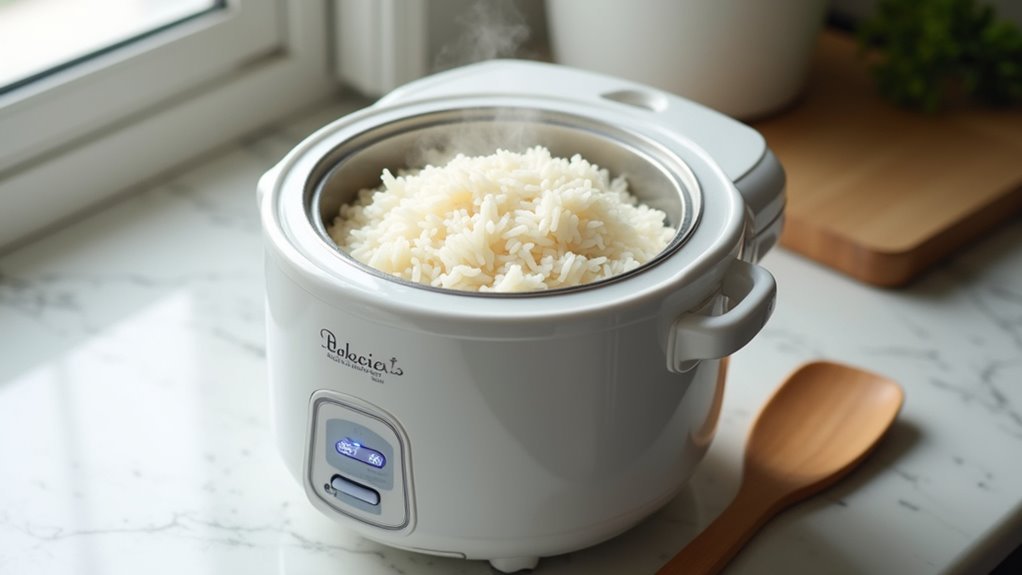
Once your rice hits that perfect doneness, here’s where things get really clever – the keep warm function kicks in automatically, and honestly, it’s like having a personal chef who never stops watching your food.
We’re talking about maintaining that sweet spot between 140°F to 160°F for up to 12 hours. Rice cookers monitor temperature constantly, adjusting heat as needed so your grains don’t get sticky or hard.
It’s actually pretty amazing – you get perfectly cooked rice that stays fluffy and ready whenever you’re hungry, no timing stress required. This feature also helps with nutrient retention, ensuring that your meal is not just delicious but also packed with essential vitamins and minerals.
Elimination of Guesswork Through Pre-Programmed Settings
If you’ve ever stood over a pot wondering whether your rice needs five more minutes or if you’ve already ruined it – well, those days are basically over. Pre-programmed settings eliminate all that uncertainty. We’re talking about rice cookers that literally think for you, using fuzzy logic technology to sense moisture and adjust accordingly. This technology is particularly beneficial during the absorption phase of cooking, ensuring optimal texture and flavor.
| Rice Type | Cook Time | Water Ratio | Special Features |
|---|---|---|---|
| White Rice | 18-20 min | 1:1.5 | Quick cooking |
| Brown Rice | 45-50 min | 1:2 | Extended cycle |
| Sushi Rice | 25-30 min | 1:1.25 | Sticky texture |
| Jasmine | 15-18 min | 1:1.5 | Fragrant setting |
| Wild Rice | 50-60 min | 1:3 | Tough grain cycle |
The automatic shut-off prevents overcooking, guaranteeing perfectly cooked rice every single time.
Frequently Asked Questions
Why Are Rice Cookers so Good at Cooking Rice?
Coincidentally, we’ve discovered rice cookers excel through cooking efficiency via precise water ratios and temperature sensors. They deliver flavor enhancement and texture consistency by automatically switching to warm mode, preventing burning while ensuring perfectly tender results.
Is Rice Better Cooked in a Rice Cooker?
We’d say yes – rice cookers deliver superior rice texture through consistent moisture control, improve cooking efficiency with automated timing, and provide better flavor enhancement by preventing burning and nutrient loss.
How to Get the Perfect Rice in a Rice Cooker?
We’ll achieve perfect rice by using correct water ratios for different rice types, rinsing grains beforehand, selecting appropriate settings, and adjusting cooking times. Let’s measure accurately and rest the rice fifteen minutes after cooking.
What Is the 123 Rice Rule?
The 123 rice rule simplifies rice measuring: we use 1 cup rice, 2 cups water, cooking for approximately 20-30 minutes. These water ratios and cooking times guarantee consistently fluffy results every time.