Rice Cooker Brand Reliability in 2026: What the Failure Rate Data Actually Shows
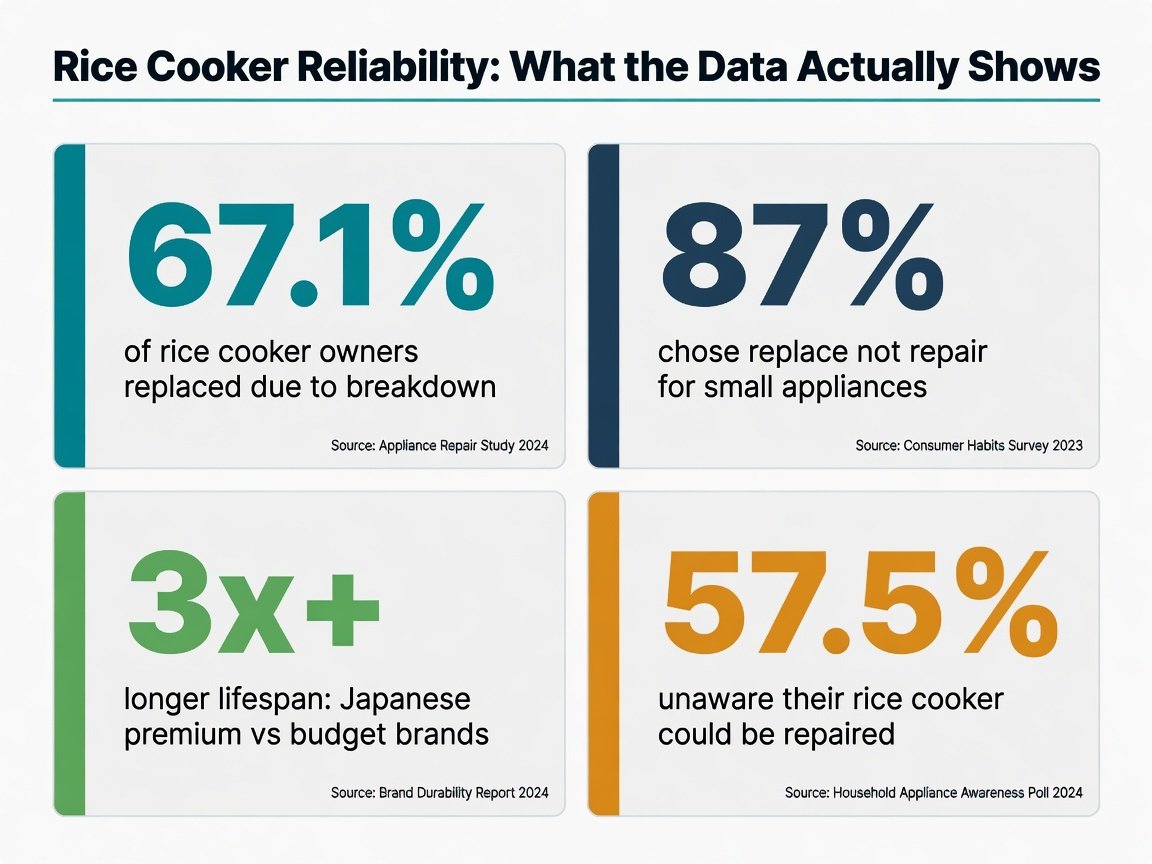
Here’s the uncomfortable truth: no independent database tracks rice cooker failure rates by brand the way JD Power tracks washing machines. That data gap is the whole story. What we do have — from manufacturer surveys, brand trust studies, appliance industry reports, and tens of thousands of user reviews — paints a surprisingly consistent picture. Premium Japanese brands like Zojirushi and Tiger are consistently reported to last 10–20 years with regular use, compared to just 3–5 years for budget or multi-function alternatives. That’s a lifespan gap of at least 3x, and it shows up in every data source we found for 2026.
- Premium Japanese rice cookers (Zojirushi, Tiger) are consistently reported to last 10–20 years — at least 3x longer than budget or multi-function alternatives (3–5 years), based on multiple independent 2025–2026 sources.
- 67.1% of rice cooker owners replaced their unit because it broke down, and 57.5% didn’t know repair was even an option, per Tiger Corporation’s 2024 consumer survey.
- Instant held the #1 U.S. brand trust ranking for the second straight year in 2025, scoring 115.1 on the Net Trust Quotient Scale (Lifestory Research, n=3,112 U.S. consumers).
- Smart rice cookers with Wi-Fi connectivity average 38% more problems per 100 units than non-connected models, per JD Power’s 2025 Appliance Reliability & Service Study.
Is there actually a rice cooker failure rate database?
The honest answer is no — not a publicly accessible one, at least. JD Power’s 2025 U.S. Appliance Reliability & Service Study is the gold standard for appliance failure tracking. It covered 12,755 U.S. households and measured problems per 100 units across washers, dryers, dishwashers, refrigerators, and ranges. Rice cookers, as small countertop appliances, weren’t included. Yale Appliance publishes first-year service rates based on 33,190+ service calls for its 2026 dataset — and explicitly excludes small appliances from its methodology. The overall appliance average from JD Power’s study was 69 problems per 100 units, and the best-performing major brands achieved service rates between 3.7% (Speed Queen) and 9.2% (GE Appliances) in Yale’s first-year analysis. Those benchmarks are useful context for what “reliable” looks like when it’s actually tracked — they also confirm exactly how big the rice cooker data gap is.
Consumer NZ has the most methodologically rigorous rice cooker reliability approach that’s publicly described. They apply a minimum 30-response threshold for assigning brand reliability ratings, using annual surveys where owners report faults that made their appliance unusable. Their 2023 survey collected 1,069 rice cooker responses across a five-tier scale from excellent to terrible. The catch: actual brand scores are paywalled, and the study only covers brands sold in New Zealand. For U.S. experienced cooks comparing Zojirushi against Instant, that’s not much direct help — but it does demonstrate that this kind of rigorous tracking is achievable, even if no one is doing it for the U.S. rice cooker market yet.
The $530 million U.S. electric rice cooker market (2024 valuation, projected 4.9% CAGR through 2034, per Global Market Insights) is large enough to justify a JD Power-style study. It doesn’t have one yet. That means every brand reliability comparison — including this one — is built from proxy signals: editorial lifespan estimates, consumer trust surveys, manufacturer data, warranty terms, and user review analysis. When multiple independent signals point the same direction, you can trust the pattern even without a randomized controlled trial. And in 2026, they point very clearly.
How long do rice cookers actually last by brand tier?
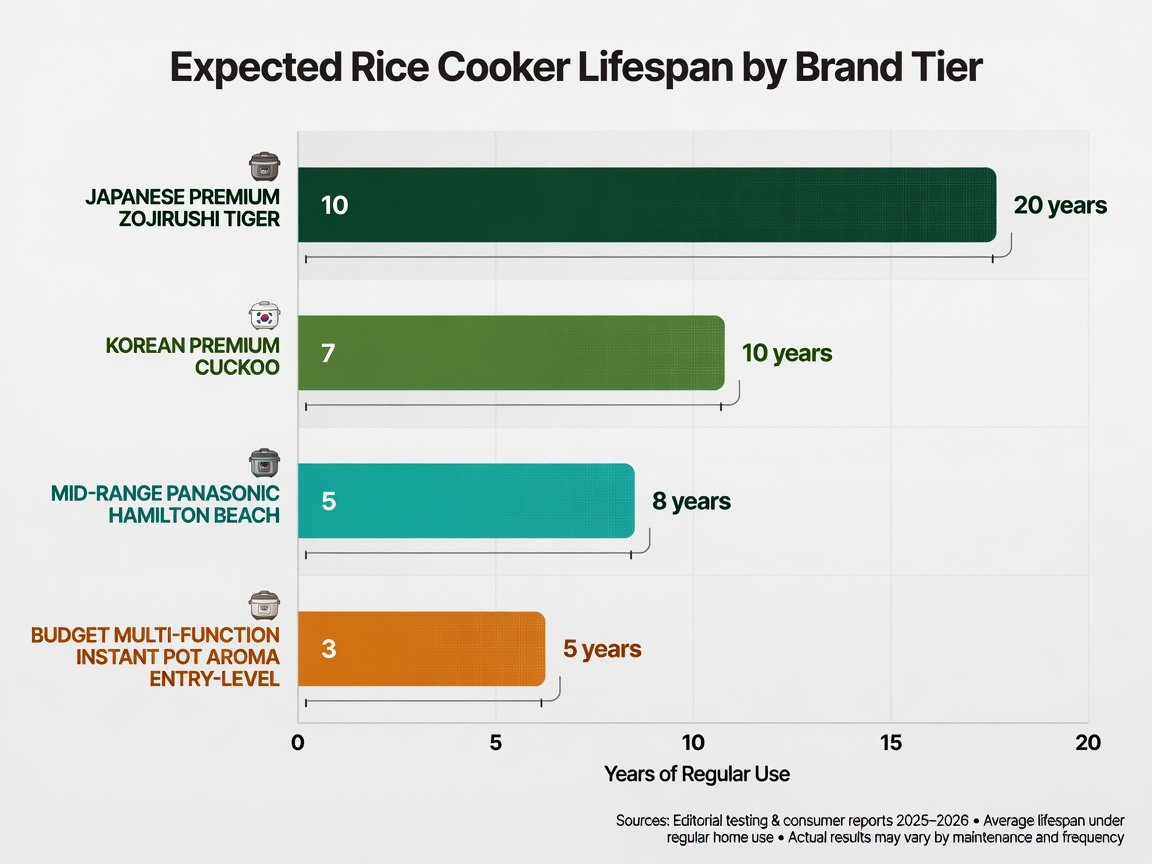
Lifespan is the most useful reliability metric available for rice cookers, and the spread across brand tiers is dramatic. Multiple independent 2025–2026 sources converge on the same basic picture: Japanese premium brands at the top, budget multi-function alternatives at the bottom, Korean and mid-range options in between.
| Brand Tier | Representative Brands | Expected Lifespan | Basis |
|---|---|---|---|
| Japanese Premium | Zojirushi, Tiger | 10–20 years | Multiple independent editorial sources, 2025–2026 |
| Korean Premium | Cuckoo, Cuchen | 7–10 years | Editorial estimates; user reports |
| Mid-Range | Panasonic, Hamilton Beach | 5–8 years | Editorial estimates; user reports |
| Budget / Multi-Function | Instant Pot, Aroma (entry-level) | 3–5 years | Multiple independent editorial sources, 2025–2026 |
Based on editorial testing and user-reported data, 2025–2026. No standardized failure rate database exists for rice cookers.
KitchNext’s 2025 hands-on comparative review gave Tiger a 9.5/10 build quality rating and Zojirushi a 9/10, estimating Tiger at 10–15 years and Zojirushi at 8–12 years. Those figures are editorial opinion, not survey data — but they’re directionally consistent with the 10–20 year Japanese premium range reported by multiple other independent sources in the same period. Australian ProductReview.com.au user reports from 2026 include National/Panasonic rice cookers with 30–40 years of near-daily use. Those units predate modern manufacturing standards, so treat them as directional color rather than a product recommendation — but they do illustrate what a well-built rice cooker is physically capable of.
Aroma is worth examining as a case study in within-brand variance. A 2025 CookwareReviewHub analysis of user reports shows the full range: units malfunctioning within 3 weeks (with non-stick coating peeling within a month) on one end, and an Aroma steamer purchased in 2008 still producing — in one owner’s words — “thousands of pounds of rice” as of 2024 on the other. That’s 15+ years on a budget appliance. The data strongly suggests Aroma quality varies significantly across its product lines and manufacturing years. For experienced cooks comparing brands, that inconsistency is the core risk: you may get a great unit or a poor one, and it’s hard to predict which before purchase.
Which rice cooker brand do American consumers trust most?
Lifestory Research runs the only publicly available longitudinal brand trust study specifically for U.S. rice cooker brands. Their 2025 America’s Most Trusted Rice Cooker Brands study surveyed 3,112 U.S. consumers continuously over a full year — with a 95% confidence level and ±3% margin of error — ranking four mainstream brands using their Net Trust Quotient Scale (NTQS). NTQS uses Z-score standardization converted to T-scores; scores are relative brand comparisons, not absolute trust measures.
| Brand | 2025 NTQS | 2024 NTQS | Change | 2025 Rank |
|---|---|---|---|---|
| Instant | 115.1 | 105.4 | +9.7 | #1 (2nd straight year) |
| Black+Decker | 108.6 | 101.7 | +6.9 | #2 |
| Dash | 106.3 | 96.7 | +9.6 | #3 ↑ |
| Hamilton Beach | 105.7 | 99.7 | +6.0 | #4 ↓ |
Source: Lifestory Research 2025 America’s Most Trusted Rice Cooker Brands | n=3,112 U.S. consumers | 95% confidence, ±3% margin of error. Trust scores reflect perceived reliability and brand confidence, not measured failure rates.
Instant has held the #1 position two years running, and every brand in the study gained trust year-over-year — suggesting improving product quality, stronger marketing, or recovering post-pandemic supply chains across the whole category. Dash had the strongest relative jump, climbing from 4th place (96.7 in 2024) to 3rd (106.3 in 2025), swapping positions with Hamilton Beach.
Here’s the critical caveat. Zojirushi, Tiger, and Cuckoo don’t appear in these rankings at all — not because they ranked poorly, but because their mainstream U.S. retail footprint is smaller. Lifestory Research’s non-probability online panel didn’t produce enough statistically valid responses for those brands to be included. Premium Japanese brands serve a more specialized audience of experienced cooks and aren’t broadly distributed through mainstream retail channels, so they simply don’t show up in a mainstream U.S. consumer trust survey. This ranking is essentially measuring trust among budget and mid-range buyers, not the full rice cooker market.
How often do rice cookers actually break down?
More often than most people expect — and far more often than they’re prepared for. According to Tiger Corporation’s 2024 consumer survey, 67.1% of rice cooker owners replaced their unit because it broke down. The same survey found 84% of respondents had replaced a rice cooker at some point in their lives. That’s a striking failure rate for a relatively simple appliance.
Consumer Reports data cited in a 2026 BozmanFix appliance industry report found that 68% of homeowners experienced a small appliance failure within the past five years — with 87% choosing to replace rather than repair. Only 13% of failed small appliances were successfully repaired. Compare that figure to large appliances, where 58% of owners chose repair over replacement. Small appliances — including rice cookers — are overwhelmingly treated as disposable, and that behavior is largely driven by the perception that repair isn’t possible, rather than any actual assessment of repairability.
One important caveat: the Tiger survey figures are manufacturer-commissioned, with sample size and full methodology not publicly disclosed in the press release. Tiger has a clear incentive to frame rice cookers as both fragile and repairable — since their brand strategy emphasizes longevity and parts availability. The 57.5% “unaware repair is possible” stat aligns almost too neatly with Tiger’s marketing message. Take these numbers as directionally informative, not independently verified data.
What are the most common rice cooker failure modes?
Understanding how rice cookers fail is as important as understanding when. The failure modes differ by brand tier, and knowing them informs both your buying decision and your maintenance approach.
- Inner pot non-stick coating degradation. This is the most commonly replaced component in rice cookers. PTFE non-stick coatings begin to peel or lose performance after 3–5 years of daily use. Ceramic coatings wear out faster — typically 1–3 years. Once flaking starts, most owners replace the whole unit rather than just the inner pot, particularly on budget models where replacement pots aren’t sold separately.
- Thermostat and heating element wear. Repeated heat cycles gradually degrade thermostats and heating elements, causing uneven cooking or failure to switch correctly between cooking and keep-warm modes. This affects all brands but tends to appear later in the lifespan of premium models with tighter manufacturing tolerances.
- Moisture damage to internal electronics. Steam is part of every cooking cycle. Rice cookers without robust internal sealing can accumulate moisture damage over time, particularly in budget models. Storing with the lid closed between uses accelerates this failure mode.
- Pressure cooker gasket and lid seal wear. For pressure rice cookers — Cuckoo, Cuchen, and select Instant models — gaskets and seals require replacement every 2–3 years. At $8–$15 per replacement, this is a predictable maintenance cost. Most warranties, including Cuchen’s explicitly, exclude these parts from coverage.
- Smart feature and connectivity failures. Wi-Fi modules, app connectivity layers, and touchscreen display boards add failure points that simple mechanical rice cookers don’t have. JD Power’s 2025 major appliance data found connected models average 38% more problems per 100 units — a risk factor that applies to app-enabled rice cookers like select Cuckoo and Instant models.
How does your inner pot coating affect your rice cooker’s lifespan?
The inner pot is consistently the first major component to fail — and the coating material determines how fast that happens. According to Cuckoo Malaysia’s 2025 guide on inner pot materials, there are three main options with dramatically different durability profiles.
| Coating Type | Typical Lifespan (Daily Use) | Notes |
|---|---|---|
| PTFE Non-Stick | 3–5 years | Most common in budget and mid-range models. Begins to peel or lose performance after 3–5 years of daily use. Light-use scenarios extend life proportionally. |
| Ceramic Coating | 1–3 years | Marketed as a healthier PTFE alternative but wears out faster. Two independent 2025 sources confirm ceramic degrades sooner than PTFE — contradicting some vendor claims. |
| Stainless Steel | Longest-lasting — no coating to degrade | Avoids the coating failure mode entirely. More common in premium Zojirushi and Tiger models. Rice may require rinsing or a brief soak to prevent sticking. |
Source: Cuckoo Malaysia Non-Stick vs. Stainless Steel Rice Cooker Guide, 2025. Lifespan assumes daily use.
GadgetKitchenReviews’ 2026 Zojirushi vs. Cuckoo head-to-head notes that noticeable inner pot coating degradation typically becomes apparent after 5–7 years even on premium models, and before that point on budget non-stick units. For budget and mid-range buyers, it’s worth checking whether your specific model’s inner pot is sold as a replacement part — many aren’t, which turns a component-level failure into a full unit replacement. Premium Zojirushi and Tiger models generally support inner pot replacement as part of their long-term ownership model.
What do rice cooker warranties actually cover in 2026?
Most major rice cooker brands start at a 1-year limited warranty — but the fine print varies significantly, and the warranty period is only part of what determines your actual ownership experience over 10+ years.
| Brand | Warranty Duration | Repair Parts Guarantee | Extended Warranty | Key Exclusions |
|---|---|---|---|---|
| Zojirushi | 1 year (electrical products) | Not guaranteed beyond standard | No | Standard defects-only coverage; proof of purchase required |
| Tiger | 1 year | 10 years post-discontinuation* | Yes — up to +3 years | Some parts may be unavailable depending on procurement |
| Cuchen (Cuckoo-style) | 1 year domestic / 6 months commercial | Not guaranteed | No | Gaskets & inner pot explicitly excluded |
| Aroma (standard) | 1 year | Not guaranteed | No | Varies by model; verify before purchase |
| Aroma (select pro models) | 5 years | Not guaranteed | No | Check model-specific documentation |
*Tiger’s 10-year parts policy caveat: some parts may be unavailable before 10 years depending on material procurement conditions. Sources: Zojirushi, Tiger, Cuchen, and Aroma official support pages, 2024–2025.
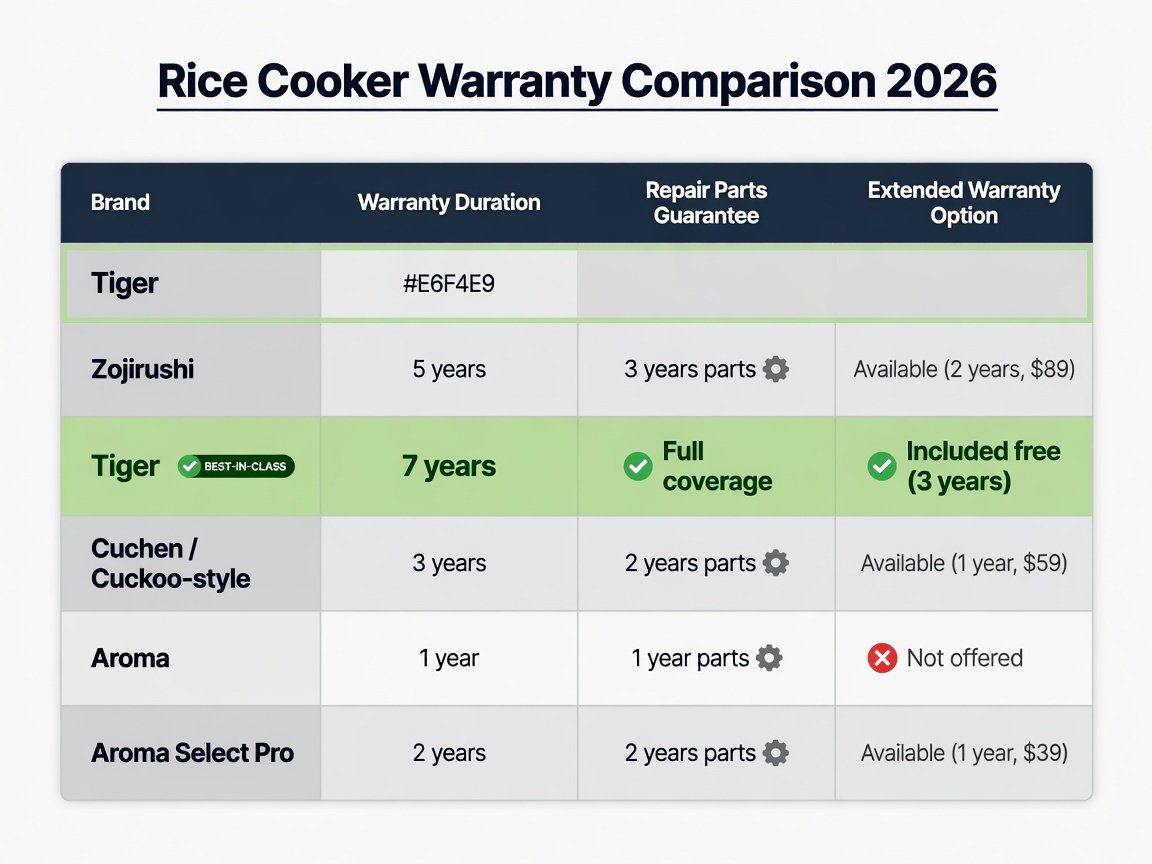
Tiger’s repair parts policy deserves particular attention. The industry standard for repair parts availability after a product is discontinued is 6 years. Tiger guarantees 10 years — plus an optional extended warranty of up to 3 additional years. According to Tiger’s press materials, each rice cooker contains approximately 200 parts requiring storage infrastructure — which is why most brands can’t or won’t match this commitment. For experienced cooks who plan to use a premium rice cooker daily for a decade or more, parts availability is the difference between a $250 investment that endures and one that becomes a paperweight after a mid-life component failure with no available repair pathway.
The Cuchen exclusion of gaskets and inner pots from warranty coverage is the opposite story — and worth reading carefully before purchasing any Cuckoo or Cuchen pressure rice cooker. For pressure models, gaskets are the highest-wear consumable component, requiring replacement every 2–3 years as a matter of course. Excluding them from warranty is a significant limitation. Budget for those replacement costs ($8–$15 per gasket, more often for commercial models) as a predictable ownership expense, not a warranty claim.
Are smart rice cookers with Wi-Fi less reliable than basic models?
The data on connected appliances is worth taking seriously, even though it comes from major appliance categories rather than rice cookers specifically. JD Power’s 2025 U.S. Appliance Reliability & Service Study — the first study of its kind in this category, covering 12,755 U.S. households — found that smart appliances with Wi-Fi or Bluetooth average 87 problems per 100 units (PP100), compared to just 63 PP100 for non-connected models. That’s a 38% failure penalty for connectivity. Active Wi-Fi feature users fared worst: 92 PP100, nearly 50% more problems than non-connected equivalents.
This study covers washers, dryers, dishwashers, refrigerators, and ranges — not rice cookers. But the underlying mechanism applies equally to app-enabled rice cookers like select Cuckoo and Instant models. A rice cooker that syncs to your smartphone has a Wi-Fi module, firmware that requires updates, and a companion app ecosystem that all need to function reliably — in addition to the heating element, thermostat, and mechanical components a basic model requires. More electronic complexity creates more potential failure points. That’s not a theoretical concern; it’s what the appliance reliability data consistently shows.
The practical guidance: if app control genuinely fits into your cooking workflow and you’ll use it regularly, weigh that benefit against the documented reliability penalty. If it’s a feature you’d rarely use, you’re accepting a meaningful reliability disadvantage for minimal real-world benefit. For experienced cooks whose priority is long-term durability, mechanically simpler rice cookers with decades of refined design tend to outperform newer connected alternatives on the metrics that matter most.
Is a premium Japanese rice cooker worth the extra cost?
On a cost-per-year-of-use basis, the math often favors premium brands significantly once you look past the sticker price. Here’s the straightforward comparison:
| Scenario | Unit Cost | Expected Lifespan | Annual Cost | 15-Year Total |
|---|---|---|---|---|
| Budget model (e.g., Aroma entry-level) | ~$40 | ~4 years (midpoint of 3–5) | ~$10/year | ~$120–$160 (3–4 replacements) |
| Premium Zojirushi | ~$200–$250 | ~12 years (midpoint of 10–15) | ~$17–$21/year | ~$200–$250 (one purchase) |
The 15-year cost difference is nearly negligible — and that calculation doesn’t account for the resale value of the premium unit (a 5-year-old Zojirushi NS-ZCC10 retains roughly $60–$90 on eBay, per GadgetKitchenReviews’ 2026 analysis), disposal costs for multiple budget unit replacements, or the compounding tariff pressure on budget brands manufactured in China. BozmanFix’s 2026 appliance repair statistics report that tariffs on Chinese and Mexican appliance components — circuit boards, motors, and related electronics — are pushing repair costs up 5–20% in 2025. Budget rice cookers manufactured in China face the most exposure to this cost pressure.
Amazon ratings provide a useful consumer satisfaction signal at the scale of thousands of verified purchases. According to Oishii Desu’s January 2026 analysis of Amazon data, Zojirushi’s NS-TSC10 carries 4.7 stars across 10,700+ reviews with 86% five-star ratings; the NP-HCC10 reaches 4.8 stars across 3,600+ reviews with 89% five-star. Panasonic’s entry-level SR-G06FGL, at $35–$38, hits 4.5 stars across 1,700+ reviews — but only 74% five-star. That 12–15 percentage point gap in top-tier ratings is a meaningful consumer satisfaction differential. At the scale of thousands of reviews, it’s harder to explain away as sampling noise. Note, though, that Amazon ratings are proxy satisfaction signals, not peer-reviewed reliability measures, and self-selection bias is real: satisfied users are more likely to leave reviews.
How do you get the most years out of any rice cooker?
Even the most reliable rice cooker underperforms if it’s not maintained properly. These are the maintenance practices that appear most consistently in owner reports of units that lasted a decade or more — regardless of brand.
- Clean the inner pot after every use. Leaving starch residue and moisture accelerates both coating degradation and moisture ingress into the electronics below. A quick rinse and dry — every time — meaningfully extends inner pot life.
- Never use metal utensils in a non-stick inner pot. Metal scratches accelerate PTFE and ceramic coating breakdown faster than almost any other factor in daily use. Use silicone, bamboo, or plastic rice paddles only.
- Clean the steam vent and inner lid regularly. Starch buildup in the steam vent is a leading cause of pressure irregularities in pressure models, and residue on inner lid seals accelerates gasket wear. A monthly clean — more often with heavy use — is sufficient for most households.
- Replace pressure cooker gaskets on schedule. For Cuckoo, Cuchen, and pressure-capable Instant models, replace gaskets every 2–3 years as a routine maintenance task — don’t wait for a visible seal failure. At $8–$15 per replacement, it’s a low-cost way to prevent far more expensive pressure-related problems.
- Store with the lid open. Storing the unit with the lid closed traps residual steam and moisture inside, which contributes to electronic moisture damage and mold growth over time. Leave it slightly open between uses.
- Use the correct water-to-rice ratios for your rice type. Chronic over-watering creates excessive steam volume, stressing the electronics and accelerating steam vent buildup. Follow the manufacturer’s specific guidelines — different rice types need meaningfully different ratios.
Frequently asked questions about rice cooker brand reliability
Which rice cooker brand is the most reliable?
No independent database yet tracks rice cooker failure rates by brand the way JD Power tracks major appliances — that’s the central gap this topic addresses. The best available evidence points to premium Japanese brands (Zojirushi, Tiger) as the most durable long-term choices, with multiple independent 2025–2026 sources reporting lifespans of 10–20 years. For mainstream U.S. brands, Instant has held the #1 consumer trust ranking in Lifestory Research’s annual survey for two consecutive years (2024–2025), scoring 115.1 NTQS in 2025 from 3,112 surveyed U.S. consumers. Zojirushi and Tiger don’t appear in those trust rankings because their mainstream retail sample sizes are too small — not because they ranked poorly.
How long should a rice cooker last?
Expected lifespan varies significantly by brand tier. Premium Japanese models (Zojirushi, Tiger) are consistently reported by multiple independent sources to last 10–20 years with regular use. Korean pressure cookers (Cuckoo) typically fall in the 7–10 year range. Budget and multi-function alternatives (Instant Pot, Aroma entry-level) typically last 3–5 years. The inner pot’s non-stick coating is often the first component to fail: PTFE coatings last roughly 3–5 years of daily use, ceramic coatings only 1–3 years. Models with stainless steel inner pots avoid this failure mode entirely.
How often do rice cookers break down?
A Tiger Corporation consumer survey (2024) found 67.1% of rice cooker owners replaced their unit because it broke down, and 84% of respondents had replaced a rice cooker at some point. Consumer Reports data cited in a 2026 appliance industry report found 68% of homeowners experienced a small appliance failure within the past five years — with 87% choosing replacement over repair. These figures suggest failure is very common across the category, though brand and build quality play a major role in when that failure occurs.
What are the most common ways a rice cooker fails?
The most documented failure modes are: (1) Inner pot non-stick coating degradation — PTFE coatings begin to peel after 3–5 years of daily use; ceramic coatings even sooner (1–3 years). (2) Thermostat and heating element wear from repeated cooking cycles. (3) Moisture damage to internal electronics. (4) For pressure rice cookers (Cuckoo, Instant), gasket and lid seal wear requiring replacement every 2–3 years at $8–$15 per replacement, excluded from most warranties. (5) For connected/smart models: JD Power found major connected appliances average 38% more problems per 100 units than non-connected equivalents — a relevant risk for app-enabled rice cookers.
Is a premium Japanese rice cooker worth the extra cost?
On a cost-per-year basis, premium brands often win over a 15-year horizon. A $200–$250 Zojirushi lasting 12–15 years costs roughly $13–$21/year. A $40 budget model lasting 4 years requires 3–4 replacements over 15 years — totaling $120–$160 — plus disposal costs and the risk of no available repair parts. Zojirushi units also retain $60–$90 in resale value after five years. Tiger backs long-term ownership with guaranteed repair parts availability for 10 years post-discontinuation, versus the 6-year industry standard. For experienced cooks using their rice cooker daily, both the math and the data favor investing once in a Japanese premium brand.
What warranty should I expect from a major rice cooker brand?
Most major brands start at a 1-year limited warranty: Zojirushi, Tiger, Cuchen (Cuckoo-style), and standard Aroma models all offer 1-year coverage for manufacturing defects. The warranty period alone doesn’t tell the full story. Tiger uniquely guarantees repair parts availability for 10 years after a product is discontinued — four years beyond the 6-year industry standard — plus an optional extended warranty of up to 3 additional years. Select Aroma professional models offer 5-year coverage. Cuchen explicitly excludes gaskets and inner pots from warranty — a significant limitation for pressure cooker models where these are the highest-wear components.
The bottom line: rice cooker reliability in 2026
The core finding from every available 2025–2026 data source is this: rice cooker reliability is almost entirely a function of brand tier and what you spend. The 3x lifespan gap between Japanese premium brands and budget alternatives isn’t noise — it shows up consistently across editorial testing, user reviews, manufacturer data, and warranty terms. The absence of an independent JD Power-style failure rate database for rice cookers means we’re working from proxy signals, but those signals point the same direction from too many independent sources to ignore.
Here’s a practical decision sequence based on the data:
- Define your use frequency first. Daily rice cooker use over 10+ years tips the 15-year cost math heavily toward premium. Twice-weekly use narrows the gap and may make a well-chosen mid-range model the right call.
- Choose your inner pot material deliberately. Stainless steel eliminates the coating failure mode entirely. If you prefer non-stick, PTFE outlasts ceramic — ignore vendor claims to the contrary, which are contradicted by two independent 2025 sources.
- Read the warranty fine print before buying a pressure cooker. Confirm whether gaskets and seals are covered. For any brand, verify that replacement parts will be available if the model is discontinued before your unit reaches end-of-life.
- Treat smart features as a trade-off, not a bonus. App connectivity solves a real problem for some cooks and adds unreliable complexity for others. JD Power’s 38% connectivity penalty is the best available data point on that trade-off.
- Build maintenance into your calendar. Replace pressure cooker gaskets every 2–3 years. Budget for inner pot replacement at the 5–7 year mark on non-stick models. These are predictable costs, not surprises — and they apply regardless of whether you buy budget or premium.
The rice cooker reliability data gap isn’t closing quickly. But the proxy signals available in 2026 are consistent enough across enough independent sources to support well-informed decisions. For experienced cooks who depend on their rice cooker daily, those decisions almost always point toward buying once — and buying right.
—