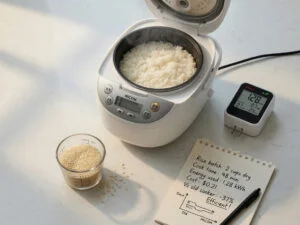
Choosing the right rice cooker comes down to four decisions: how much rice you need to cook, what technology suits your cooking style, which features you’ll genuinely use, and how much you want to spend. Get those four right and you’ll eat consistently better rice — every single time.
Rice is a dietary staple for billions of people worldwide, and for good reason. It’s affordable, versatile, and deeply satisfying. But cooking it well is deceptively tricky. Water ratios, heat levels, timing — there are more variables than most people realise, and the stovetop method gets them wrong more often than not. A rice cooker removes most of those variables in one go.
The challenge is picking the right one. The market runs from sub-£20 basic models to £300-plus induction-heating machines with more settings than a smartphone. Knowing what actually matters — and what’s just marketing — is exactly what this guide is here to sort out.
Key Takeaways
- Size first: Always match capacity to your actual household needs — buying too small is the single most common mistake rice cooker buyers make.
- Technology matters: Fuzzy logic and induction heating models consistently outperform basic on/off machines for texture and consistency across different rice types.
- Inner pot quality: The coating material and pot thickness directly affect how evenly your rice cooks and how long the machine stays in good working condition.
- Features add real value: Keep-warm, delay timers, and steam vents are genuinely useful; know which extras you’ll actually reach for before paying for them.
Why Does Getting This Decision Right Actually Matter?
You might assume a rice cooker is a rice cooker — pour in rice and water, press a button, done. In practice, the machine you choose makes a real, measurable difference to what ends up in your bowl. The fundamental gap comes down to how each type of machine handles heat throughout the cooking process.
A basic model uses a simple thermostat that clicks off when the inner pot reaches a set temperature. It works reliably for standard white rice cooked the same way every time, but it applies an identical heat profile regardless of what you’re cooking. Jasmine, basmati, or brown rice all get the same treatment — and only one of them is likely to turn out exactly right.
More sophisticated machines monitor and adjust heat throughout the cooking cycle. They can account for how much rice is in the pot, how quickly moisture is being absorbed, and make real-time corrections. The practical result is better texture, fewer burnt or undercooked batches, and consistent results across different rice varieties. Over hundreds of uses, that consistency is genuinely valuable.
Getting the size wrong creates a separate set of frustrations. A machine that’s too small means cooking in batches, which defeats the purpose of the appliance. Too large and the heat distribution — calibrated for fuller loads — works less effectively when the pot is barely a third full. Both situations are easy to avoid with a little upfront thinking, which is exactly what the next section covers.
What Size Rice Cooker Do You Actually Need?
Capacity is measured in dry, uncooked cups — and this is where a lot of buyers trip up. A 5-cup rice cooker doesn’t produce 5 cups of cooked rice. It produces approximately 10 cups, because rice roughly doubles in volume during cooking. Keep that in mind whenever you’re reading specifications or comparing models.
Rice roughly doubles in volume when cooked — a 5-cup machine produces approximately 10 cups on your plate.
Here’s a straightforward capacity guide to match your household size:
| Household Size | Recommended Capacity | Cooked Rice Output |
|---|---|---|
| 1–2 people | 3-cup | ~6 cups cooked |
| 2–4 people | 5.5-cup | ~11 cups cooked |
| 4–6 people | 8-cup | ~16 cups cooked |
| 6+ people / batch cooking | 10-cup or larger | ~20 cups cooked |
If you live alone or cook for two, a compact 3-cup model is the right call. These take up minimal counter space, sit at the affordable end of most brands’ ranges, and are the easiest to store in a smaller kitchen. If worktop or cupboard space is a real constraint, there’s a detailed breakdown of optimal rice cooker sizes for compact kitchens that’s worth reading before you commit to anything.
At the other end of the scale, regularly cooking for six or more — or batch-cooking large quantities for the week — puts you in 10-cup territory or above. The benefits of going large extend beyond raw volume: bigger models often include more robust heating elements and better-engineered keep-warm systems as standard. There’s a solid case for choosing a large capacity rice cooker that goes well beyond just feeding more people.
One important note before you decide: most manufacturers recommend filling to 50–80% of rated capacity for best results. A 10-cup model used daily to cook 2–3 cups of rice isn’t performing at its best — the heat distribution and timing are calibrated for fuller loads. Match the machine to your typical serving size, not your occasional maximum.
What Are the Different Types of Rice Cooker Technology?
Once size is sorted, technology is the next big decision — and the one that explains most of the price differences you’ll encounter. There are four main types, each with a distinct performance profile.
Basic On/Off Models
The most affordable option. A bimetallic thermostat triggers the switch: when water is absorbed and the inner pot temperature rises above 100°C, the machine clicks off and shifts to a low-heat keep-warm mode. Simple, reliable, and entirely adequate if you cook the same type of white rice consistently.
The limitation is inflexibility. These machines cannot adjust for different rice types. Brown rice, which needs a longer cook cycle at lower heat, is beyond what a basic model can deliver reliably. If plain white rice is all you ever cook, this matters very little. If it isn’t, it matters quite a lot.
Fuzzy Logic (Micom) Models
A meaningful step up. Fuzzy logic machines use a microcomputer chip to monitor temperature throughout the cooking process and make continuous adjustments. The practical result is better-textured rice, fewer burnt or undercooked batches, and far more consistent results across different varieties — sushi rice, mixed rice, porridge, and more all get their own optimized setting.
The entry price for fuzzy logic has dropped significantly over recent years, which makes it hard to justify the basic tier unless your budget is very tight. If you want to understand exactly what separates a capable machine from a basic one, the detail behind what makes fuzzy logic control worth choosing is worth reading before you decide.
Induction Heating (IH) Models
Induction heating models generate a magnetic field that heats the entire inner pot — walls and base simultaneously — rather than applying heat from a single element beneath the pot. This produces more even heat distribution throughout the cooking process and gives the machine finer temperature control at every stage of the cycle.
The quality difference compared to standard fuzzy logic is real and consistent: more even cooking, better individual grain definition, and noticeably improved texture. IH models typically cost two to three times as much as comparable fuzzy logic machines, but for daily serious rice cooking, the investment makes sense. If you’re exploring this tier, the practical guidance on getting the best results from induction heating technology is a useful starting point.
Pressure + Induction Heating Models
The most advanced — and most expensive — category. These machines combine induction heating with pressurized cooking, which raises the boiling point of water and dramatically shortens cook time. The texture produced is distinctly different from other methods: slightly stickier, with more pronounced individual grain definition — closer to high-end restaurant rice than anything a standard machine can achieve. Premium Japanese brands like Zojirushi and Tiger dominate this space, and the price reflects it.
What Features Should a Good Rice Cooker Have?
The features list on a rice cooker box can run to fifteen or twenty items, which makes it genuinely difficult to separate useful from gimmick. Here’s a clear-eyed look at what actually makes a difference in daily use — and what you can comfortably ignore.
Automatic Keep-Warm
This is a must-have, not a luxury. Once cooking is complete, a good keep-warm system holds rice at a safe serving temperature — typically around 65–70°C — without continuing to cook it. A quality implementation maintains moisture and texture for two to four hours. Poor implementations dry the rice out or let it sit at a temperature that promotes bacterial growth. There’s more to this feature than the name suggests, and understanding exactly what your rice cooker’s keep-warm function does will help you get the most from it.
Delay Timer
Set the machine to start cooking at a specific time, up to 24 hours in advance. Load rice and water in the morning, set the timer, and come home to freshly cooked rice — or set it before bed and wake to hot porridge. It sounds like a small convenience until you’ve used it consistently, at which point it becomes a habit that’s hard to give up.
Steam Vent
A properly designed steam vent prevents the cooker from boiling over and making a starchy mess on your counter. This is especially relevant with higher-starch rice varieties that generate more foam during cooking. Better models include a condensation collector — a small cup or tray that catches drips — that removes and rinses easily. On cheaper models, this detail is often poorly designed and easy to forget entirely.
Steaming Tray or Basket
One of the most underrated features in the category. A steaming tray sits above the rice while it cooks, letting you prepare vegetables, fish, dumplings, or eggs simultaneously. One machine, one process, one complete meal — no extra pots, no additional timing to manage. The range of things you can do with a well-designed rice cooker steaming setup is broader than most people expect, and it genuinely changes how you use the appliance day-to-day.
Multiple Rice Settings
Dedicated settings for white rice, brown rice, sushi rice, mixed rice, and porridge adjust cook time and heat profile for each variety. If you regularly cook more than one type of rice, these settings make a noticeable difference. On basic models, you’re adjusting water ratios and hoping for the best. On a machine with dedicated modes, the machine does that work for you.
Nice to Have, Not Essential
- Clear glass lid — lets you monitor progress without lifting the lid and releasing steam
- Removable inner lid — makes thorough cleaning significantly easier and is standard on better models
- Digital display — genuinely useful when managing timers and multiple settings; unnecessary on simpler machines
- Non-stick spatula and holder — a thoughtful inclusion, but not a reason to choose one model over another
Which Inner Pot Material Should You Choose?
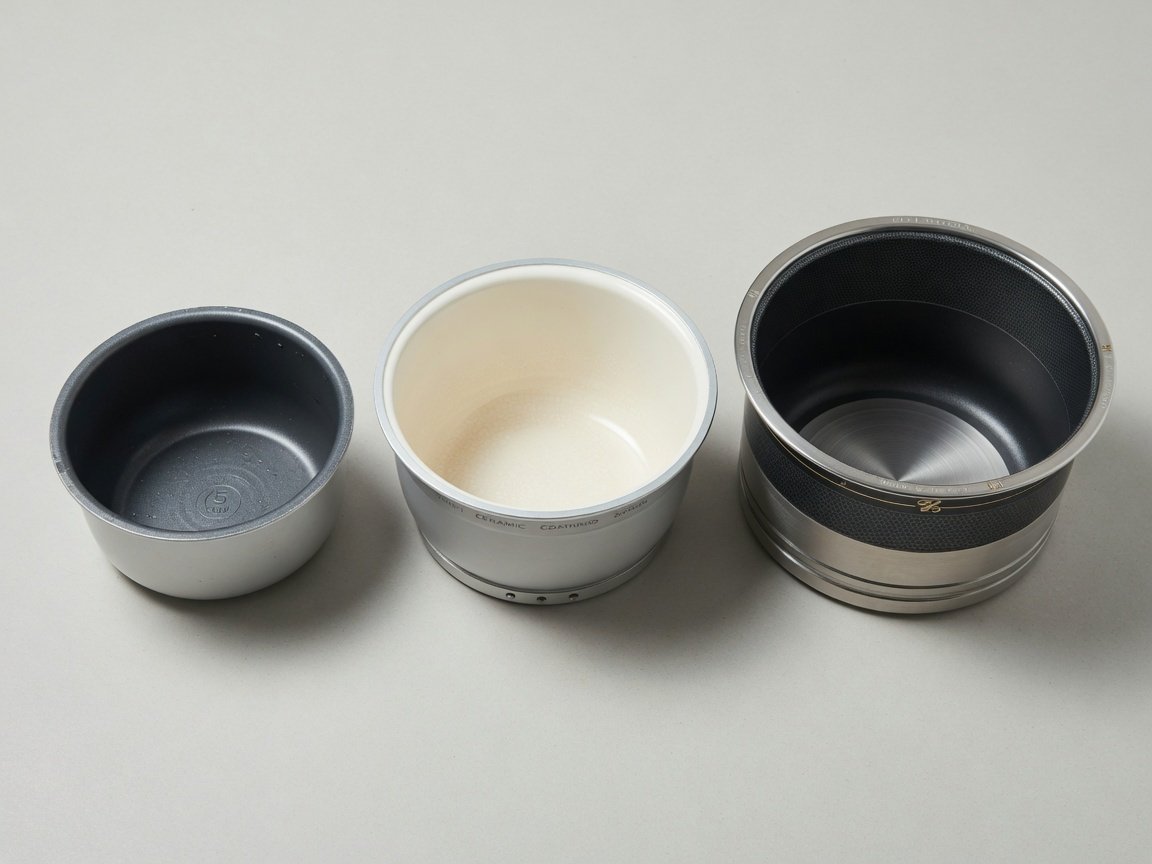
The inner pot is the heart of the machine — it’s what conducts heat to your rice and what you’re cleaning after every single use. Its construction quality is one of the most reliable indicators of a rice cooker’s overall build standard, and it’s worth scrutinizing before you buy.
Most mid-range models use an aluminium pot with a non-stick coating. When new, this works well — rice releases cleanly, cleanup is quick, and heat distributes reasonably evenly. The catch is durability. Non-stick coatings degrade over time, and the pace of degradation depends heavily on how the pot is used and maintained. Metal utensils, abrasive scrubbing tools, and dishwasher heat all accelerate wear. A peeling or scratched coating is both a performance problem and a hygiene concern. Knowing what to watch for as a non-stick coating starts to show wear — and when it means it’s time to replace the pot or the machine — is useful knowledge before you’re faced with the decision.
Premium models use thicker pots — sometimes with multiple layers — made from stainless steel, cast aluminium, or ceramic-coated materials. These are more durable, heat more evenly across the full surface area, and don’t carry the same long-term coating concerns. If you’re investing at the higher end of the market, inner pot quality is one of the clearest places where that extra spend is justified.
Key things to check when comparing inner pots:
- Thickness: Thicker pots distribute heat more evenly and are less prone to scorching near the edges
- Coating layers: Multi-layer coatings significantly outlast single-layer options — check the spec sheet
- Material: Ceramic and stainless options generally outperform basic aluminium at equivalent thicknesses
- Measurement markings: Clear cup and water-level markings for different rice types are a small but genuinely useful daily detail
How Easy Is a Rice Cooker to Clean?
Cleaning ease doesn’t feel like a priority in the shop — but it becomes very real after the fifteenth time you’ve scrubbed starchy residue from a crevice inside the lid. It’s worth factoring in before you commit to a machine.
The inner pot on most models is dishwasher safe, though hand washing is gentler on the non-stick coating and extends its useful life. The more meaningful differentiator between models is the lid. Fixed lids with internal channels trap condensed starchy steam over time and are notoriously difficult to clean thoroughly. A removable inner lid that separates completely and rinses under the tap is a significant quality-of-life improvement. It’s standard on mid-range and premium machines; almost entirely absent on budget ones.
The steam vent and condensation collector are also worth checking before you buy. On well-designed machines, these components remove easily and rinse in seconds. On poorly designed ones, they’re awkward to access and easy to overlook — leading to build-up that affects both hygiene and performance over time. A few minutes researching these maintenance details before purchase can save a great deal of frustration later.
How Much Should You Spend on a Rice Cooker?
The rice cooker market spans a genuinely wide price range, and the good news is there’s real value at every level — if you know which tier matches your cooking habits. The risk is buying below your actual requirements, which leads to frustration quickly, or buying above them and paying for refinements you’ll never notice.
| Tier | Price Range | What You Get | Best For |
|---|---|---|---|
| Entry-level | Under £30 / $30 | Basic on/off, simple keep-warm, single rice setting | Occasional cooking, very tight budget |
| Mid-range | £35–£80 / $35–$80 | Fuzzy logic, multiple settings, delay timer, steam tray | Most households — the best value point |
| Premium | £80–£200 / $80–$200 | Induction heating, thick inner pot, advanced programmes | Rice enthusiasts, daily heavy use |
| High-end | £200+ / $200+ | Pressure + IH, premium construction, maximum consistency | Serious home cooks, restaurant-quality results |
For most households, the mid-range tier offers the strongest overall value. Fuzzy logic is standard at this price point, build quality is solid, and the features that make daily use genuinely better — delay timer, keep-warm, multiple settings — are all present. Going below this tier means accepting real performance limitations. Going above it means paying for refinements that reward daily, serious rice cooking — which is a perfectly valid reason to do so, if that describes you.
If you’ve settled on a budget, consider stretching it by 15–20%. In the rice cooker market, that increment regularly buys a meaningful and measurable step up in quality.
Which Brands Are Worth Considering?
The rice cooker market is led by a handful of Japanese brands that have spent decades refining these machines. Quality shows in specific, measurable details — seal integrity, inner pot thickness, lid mechanism smoothness, keep-warm consistency — and the leading names deliver reliably on all of them.
Zojirushi is the most consistently recommended brand across every tier from mid-range to premium. Their fuzzy logic and induction heating models are particularly well-regarded for build quality and longevity. A Zojirushi machine, properly maintained, routinely lasts a decade or more.
Tiger is Zojirushi’s closest rival and offers comparable quality, sometimes at a slightly more accessible price point. Their pressure-plus-IH models are among the best available in the category.
Panasonic offers reliable mid-range machines that consistently outperform their price. A strong starting point for anyone stepping up from a basic model for the first time.
Aroma and Hamilton Beach are widely available in North America at budget-to-mid-range prices. Performance is solid for the cost, though construction quality doesn’t match the Japanese brands when you’re comparing equivalent price points side by side.
How to Choose Your Rice Cooker: Step by Step
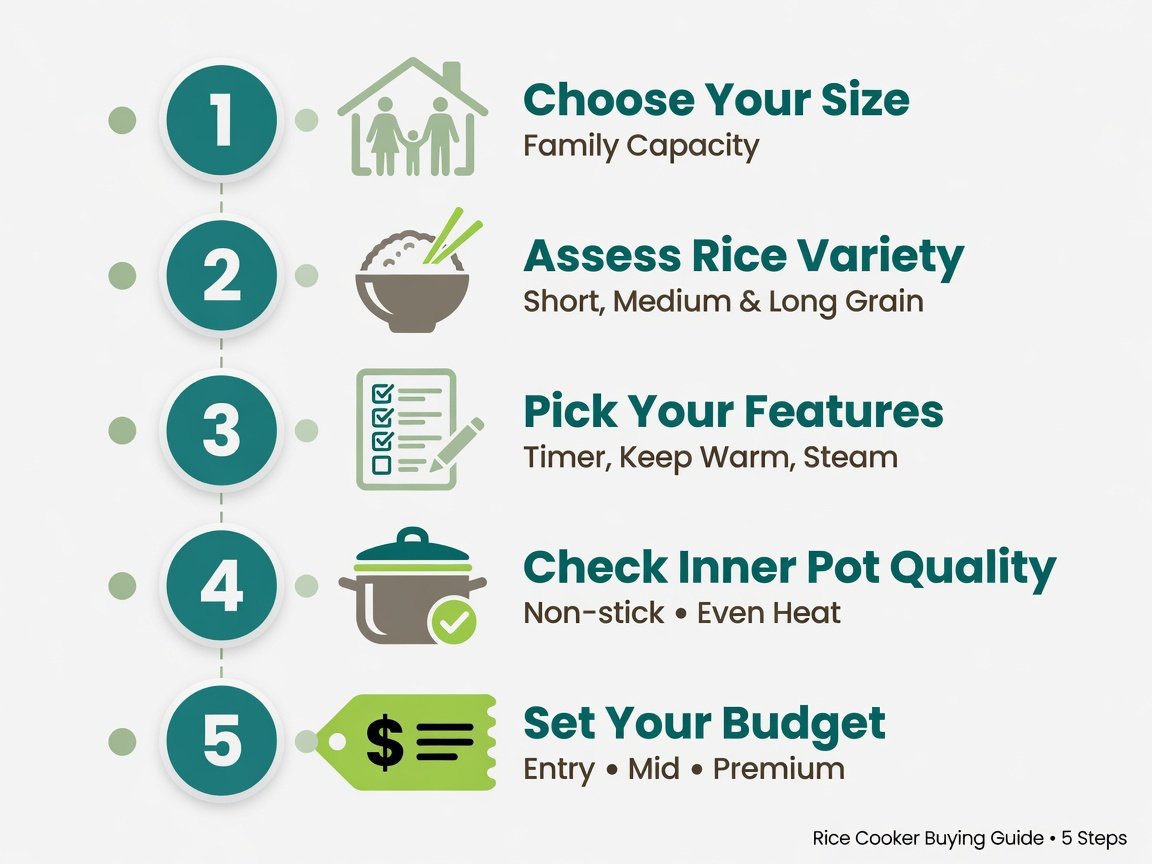
Work through these five steps in order and you’ll sidestep the most common buying mistakes — and end up with a machine that genuinely suits how you cook.
- Decide your typical portion size. Think about how much rice you cook on an average weeknight — not the maximum for a special occasion. Use the capacity table above to find the right cup size. When genuinely unsure between two adjacent sizes, go one step up.
- Assess how varied your rice cooking is. If plain white rice is all you ever cook, a basic or entry-level fuzzy logic model is entirely sufficient. If you cook brown rice, sushi rice, or congee regularly, dedicated settings are essential — which means fuzzy logic as a minimum, full stop.
- List the features you’ll actually use. Delay timer? Only worth paying for if you’ll genuinely schedule cooking in advance. Steaming basket? Useful if you want to cook vegetables alongside the rice. Keep-warm? Almost universally useful. Be honest about your habits rather than your intentions.
- Evaluate the inner pot quality. Check coating thickness and material. If you want the machine to last five or more years without replacing the pot, prioritize a thicker, multi-layer coating. Manufacturers usually list this in the specs — sometimes in small print.
- Set your budget, then add 20%. Decide what you’re comfortable spending, then ask whether stepping up slightly buys a meaningful improvement. In this category it usually does, particularly in the £40–70 / $40–70 range where the jump to the next tier is often well worth making.
Frequently Asked Questions
How many cups does a rice cooker actually produce?
Rice cooker cups refer to dry, uncooked rice. A 5-cup rice cooker takes 5 cups of uncooked rice and produces approximately 10 cups of cooked rice, because rice roughly doubles in volume during cooking. This is one of the most common sources of confusion when comparing models — always check whether a quoted figure refers to dry or cooked capacity before you draw conclusions about whether a size is right for you.
Is fuzzy logic really worth the extra cost?
For most households, yes. Fuzzy logic machines consistently produce better-textured rice than basic on/off models, and the performance gap is noticeable across different rice varieties. The price difference between basic and entry-level fuzzy logic has narrowed considerably in recent years, which makes the step up easier to justify than it used to be. If you cook rice more than a few times a week, or if you cook multiple rice types, the upgrade pays for itself quickly in fewer wasted or disappointing batches.
Can a rice cooker handle brown rice properly?
A basic model can attempt it, but results are often inconsistent — undercooked in the centre, too chewy, or unevenly textured throughout the pot. Brown rice needs a longer cook cycle at lower, more controlled heat, which basic on/off machines aren’t designed to deliver. A fuzzy logic model with a dedicated brown rice setting handles it properly and reliably. If brown rice is a regular part of your diet, that setting is worth specifically checking for when you’re comparing models.
How long should a rice cooker last?
A quality machine from a reputable brand should last 8–15 years with normal use. The inner pot’s non-stick coating is typically the first thing to degrade, usually after three to five years of daily use depending on how well it’s maintained. In many cases, replacement inner pots are available directly from the manufacturer at a fraction of the machine’s original cost — which is often a better option than replacing the whole unit. Proper cleaning habits and avoiding metal utensils in the pot extend coating life significantly.
What’s the practical difference between induction and regular rice cookers?
A conventional rice cooker heats from a single element beneath the inner pot. An induction heating model generates a magnetic field that heats the entire pot simultaneously — walls and base — producing more even heat distribution and finer temperature control at every stage of the cook cycle. The result is more consistent rice texture throughout the pot, with no cooler areas near the edges. The quality difference is real and consistent; the question is whether it justifies the price premium given how often you’ll cook and how much the result matters to you.
Do I actually need a delay timer?
Only if you’ll use it. If your schedule allows you to start cooking just before you eat, the timer adds nothing. But if you regularly arrive home hungry with no time to wait, or if you want hot porridge ready when you wake up, a delay timer becomes genuinely valuable — particularly when paired with a quality keep-warm function that maintains the result after cooking completes. It’s one of those features that’s easy to dismiss until you’ve used it a few times.
Can a rice cooker cook things other than rice?
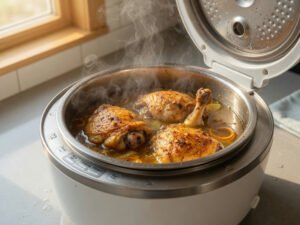
Yes — and this is one of the most overlooked aspects of the appliance. Most rice cookers handle oatmeal, soups, stews, quinoa, and steamed vegetables without difficulty. Models with a steaming basket extend this further, letting you build a complete meal in a single machine. Higher-end models sometimes include specific settings for cakes, bread, and even yoghurt. If meal versatility matters to you, look for a model with multi-cook or slow-cook settings and a steaming basket included in the box.
The Bottom Line
Choosing the right rice cooker isn’t complicated — but getting the decisions in the right order makes a real difference to how satisfied you’ll be with the result. Start with size, because a machine that’s wrong for your household will frustrate you regardless of how many settings it has. Then address technology: if you cook rice regularly and care about consistency, fuzzy logic is the minimum worth aiming for. Induction heating is a genuine step up, but worth the premium only if you’ll use it daily and notice the difference.
After that, focus on features you’ll actually reach for, examine inner pot quality carefully, and set a budget that allows a meaningful step beyond the bare minimum. The difference between a machine you’ll still rely on in ten years and one you’ll replace in two is usually a matter of knowing where to spend a little more — and now you do.
—